

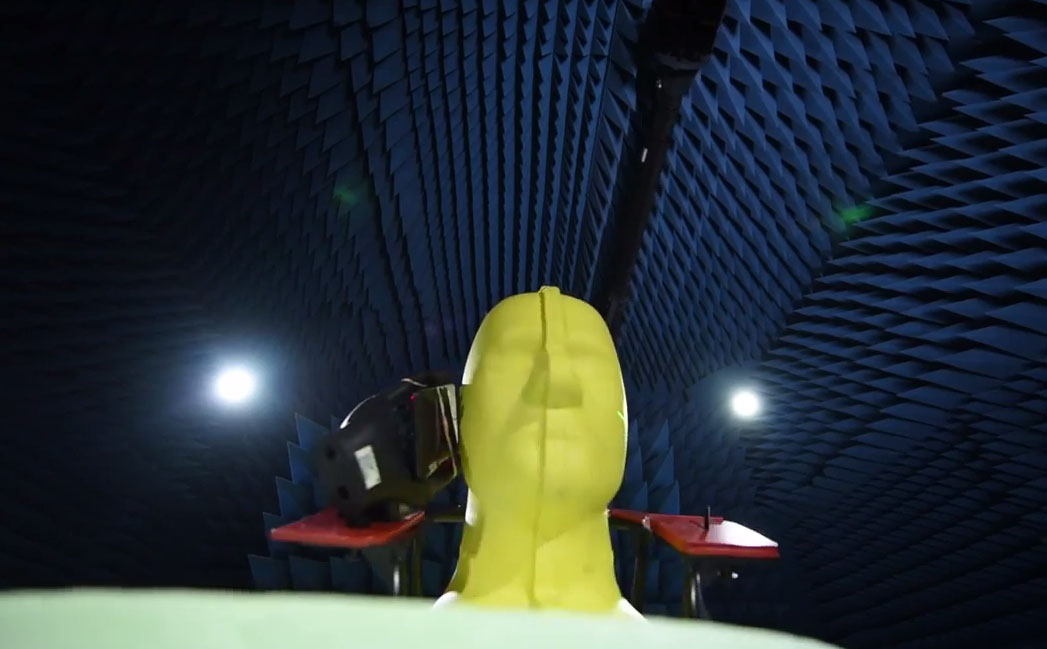

Ever wonder what goes into Verizon’s extensive (read: incredibly slow compared to others in the industry) testing process for phones? Through a series of videos called “The Device Lab,” Big Red is trying to take us through their procedures, from testing durability (something I thought manufacturers already did) to making sure your phone has the best connection to their network.
In the videos below, Verizon walks through the Antenna Chamber and drop test areas of their testing lab. In each area, they try to simulate things like windpant pocket drops during your Aunt Gertrude’s annual summer picnic at the waterslides or figure out why you have the worst cell signal out of the three brosephs you are chillaxing with on your way to the club.
If anything, just know that your Lollipop update is probably spinning around in the fake hands of a fake head as you read this…before it gets drop tested, again. This is also where the Nexus 6 is. Probably the Galaxy Nexus too.
[responsive_vid]
[responsive_vid vid_url=”eqFcZpeXJsU”]



It would be awesome to see all of this data measured and compared in a consistent way, and released to the public–though it would probably ruin some companies.
After watching those videos, a few things occurred to me.
1. If they test the signal so well, how do phones like the iPhone 4 and Galaxy Nexus with their notoriously bad radios happen? Granted, that was a few years ago, but I have still found that some companies (Motorola, LG) tend to get better reception than the competition regardless of what Verizon says.
2. I suspect that signal test is also why Verizon phones have a tendency to heat up as they struggle to maintain a connection instead of dropping to a lower power band. Now that my Moto X is on T-Mobile, it scales the radio between H, H+, and LTE depending on what is available that is the most power efficient.
3. Now I see why they chose Motorola to make the Droid line. They’re just about the only company that has consistently made phones that are extremely durable.
Sweet, now where’s the video explaining their X-UIDH tracking and how its there to give us the best experience? Punks.
I didn’t see them testing a Nexus 6…
And I thought they just had a nerdy guy in glasses that just walked around everywhere saying, “Can you hear men now?”
“Can you hear men now?”
“Gooooood!”
Guess they did not have this for the Galaxy Nexus days. Lol.
Maybe they are saying the new Sammy phone is not such a great idea.
Ahhhh, now I understand the Verizon logo after all these years. It’s a cell phone hitting the ground.
So I watched the video about the signal quality and I want to know if they have actually found phones that failed. I don’t believe I have heard about Verizon sending phones back and telling the OEM they need to redesign the antenna placement, so what good is this testing process actually doing??
The Nexus 6 may have been returned because it works better than the droids. /s
Verizon: Apple, we want to let you know about a few issues we’ve found with your devices.
Apple: You’re testing them wrong.
I was just surprised the videos weren’t 4 months long.
I was really waiting for the video to be from the Onion
Guess they didn’t extensively test the g2. Slid out of my pocket while sitting down from a height of about 20-30 inches and the thing completely shattered.
Or, they could just read the spec sheet that the OEM sends with the unit, and save the money…
Clearly they didn’t test the Galaxy Nexus on their network.
Hence why they won’t touch Nexus with a 10ft pole
Or the thunderbolt, I literally watch someone drop their thunderbolt 1 foot or less and the glass and digitizer both shattered.
I have dropped my GNex and GS3 100 times each and never had a problem, just put the battery and back plate back on, boot right up, not even a scratch on the glass.
how many of these tests or on what phones does verizon do? If vzw is doing these call / drop tests, how do they come to the conclusion that oh no it dropped and everything’s cracked and shattered is acceptable? And if their dropping it in their test and it isn’t breaking then maybe the guy who designed that test to simulate the real world should be fired.
Every phone tested. That’s good. I see the results are fantastic.
Which is why in 5 different spots in my house my:
G2 had 4-5 Bars 4G
G3 had 3-4 bars 4G
Droid Turbo has 2-3 bars 4G
Moto X had 1-3 bars 4G
Note 2 and S3 had 1 bar 4G-3 bars 3G
Note 3 had 1-3 bars 3G.
You’re welcome to use my house for testing, Verizon. Just know it doesn’t have any cool useful spikes in it.
Lol. I think the bars are just for decoration.
Report back in dbm and then compare. Bars are just a relative representation…not even all devices use the same amount of total bars. Remember the complaints of low bars after an android update (don’t remember which one) and so in the next update they just changed the calculation so you had more bars…
Sad but true. Verizon released a statement, reported here at DL, that they would change the bars to make it look like there is a better signal than there actually is.
I really doubt VZ is getting a Nexus 6, especially with leaks of a Motorola Droid branded device which is “nearly identical” to it making the rounds online.
Source?
Doesn’t matter, every Nexus 6 has the radios for VZW cdma and lte inside, so the consumer already wins, except for those who want a subsidy.
I have to pay full price for mine, but I knew that ahead of time and budgeted for the phone.
And except for those who want voice and data at the same time. It won’t happen until Verizon supports the Nexus 6.
Do they have a lab of unsuspecting customers where they test to see how much money they can squeeze out of them? Wanna buy a case with that? lol
This is like having a car dealership running crash tests on their new cars. Leave the engineering and test work to the manufactorers, stick to sales.
If best buy was the one doing the testing, I’d agree with that analogy. Neither Best Buy nor the dealership have skin in the game once you’ve purchased from them (for the most part). Verizon, as well as other carriers, have to ensure their customers are happy with the service and in order to do that they have to ensure the phones they sell work on their network under “typical” use. The average person will often assume the issue lies with the service even if the problem is with the phone.
While I can see your point, Verizon (or any of the big carriers for that matter) have quality standards from their suppliers. They set a standard in which their vendors have to adhere to, it is the vendors’ (Apple, Samsung, Moto, etc) responsibility to ensure that their products meet those minimum standards. If they fall short, they should be held liable. Case in point would be a store like Costco. They have an “in-house” (Kirkland I think) brand that is manufactored from all outside sources. These products have to meet strict guilines and quality benchmarks that Costco sets for them. It is the manufactorer’s responsibility to test and QA their products before they hit the shelves of Coscto, not Costcos.
Makes you wonder how the Galaxy Nexus ever made it to the shelves if their testing was so complete.
But how do CostCo or Verizon *know* that the quality standards are not being met? I guarantee you CostCo does or contracts out independent testing of its house brands periodically.
Isn’t that what FCC certification is for? It’s pretty extensive.
Honestly, Verizon must’ve put some of the Samsung devices that received botched updates in a drawer somewhere and claimed to “test” them.
I wonder if they test how rooted and unlocked phones run on the network. Since they claim they would have an effect on the network
They probably assume it’ll do this…
http://gph.is/1hCzwgU
wait, they’re not swimming in a pile of cash while laughing at us waiting for updates?
That’s in the sex video.
It’s great to know that Verizon wants to unnecessarily test things of the phones they sell as if the OEMs themselves didn’t already test these things.
nah… they just want to make a cool video, hoping people will feel better about paying through the nose for Big Red.
I pay less than $48 per line after fees and taxes, sharing 10GB. About as good as I can get from “budget” carriers with inferior service.
That’s not bad, you’re well below the average though. Average single line is over $100/month now, which is outrageous IMO.
My perspective may be alittle different. I’m willing to make some compromises to save money. After all taxes and fees I pay $28.84 for a single line with unlimited 3G on Sprint’s network (through Republic Wireless).
Average single line is over $100/month? Can you link a source for that b/c that seems awfully, well, off… not being snarky either, that just doesn’t add up.
I’m not finding the specific statistic I recall seeing with the average for single line, but this article talks about the average per account, and it wouldn’t be that far fetched to say the average single line is at least $100, after looking at these numbers.
http://www.fiercewireless.com/story/report-verizon-has-most-customers-paying-more-100-average/2014-07-21
Hmm… Verizon doesn’t seem to offer more than 2GB of data for a single line plan… i assume they probably offer more over the phone though (some carriers have these ‘hidden’ plans). http://www.verizonwireless.com/wcms/consumer/shop/shop-data-plans/single-line-data-plans.html
Here’s another, this one says “the average monthly cellphone bill from smartphone giant Verizon Wireless was a staggering $148 per month in the fourth quarter of 2013, according to recent research.”
Again, not quite what I was looking for, but close.
http://money.usnews.com/money/blogs/my-money/2014/07/03/5-low-cost-alternatives-to-your-pricey-cellphone-plan
Thanks – that’s interesting… I guess I’ve been off of single lines for so long I’ve only been looking at it from the 2+ line perspective.
So my Nexus 6 is spinning around a fake head somewhere?
Thanks Verizon!
Yep, being held in place by a high tech rubber band!
That hand doesn’t look big enough. Hopefully they have another one to use.
Ya know, I originally thought the Nexus 6 was way to big but after trying it I’m having second thoughts.
Big phones need love too.
I love em – just some people look funny with them.
I love mine, don’t care if people are amused. I think the size is perfect. Maybe I have large hands.
Awaiting logo placement tests…
haha yeah right which lab is this one in.
this lab http://media.tumblr.com/0d60a4f7352daf9d4326b78474d735e8/tumblr_inline_n7zzlhYTbh1qznfri.gif
Does look like Verizon.
Or which clown is responsible for this, you know he hiding in some corner with accounting label but really does logo placement
That is what takes up the other 3 months and 29 days of a Verizon update approval timeline.