
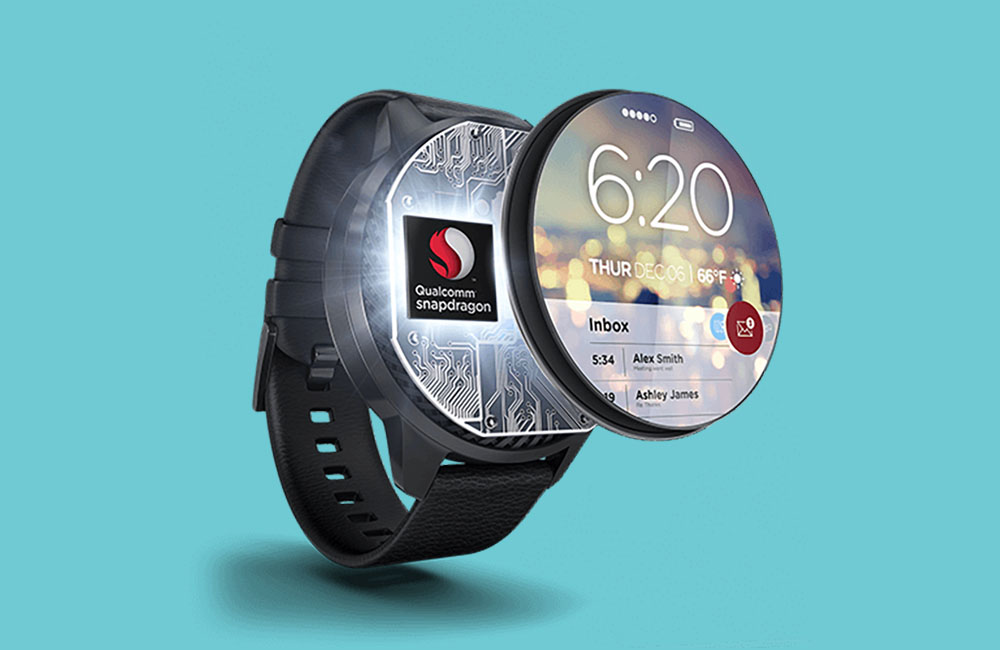

This week, a new Snapdragon Wear processor has entered Qualcomm’s family of wearable SoCs, the Snapdragon Wear 1100. Positioned to compliment the more-powerful Snapdragon Wear 2100 SoC, the Wear 1100 is designed to be an ideal processor for child and elderly smartwatches, as well as fitness trackers and smart headsets. Devices in these categories usually do not need as much power as your standard Android Wear smartwatch, so Qualcomm is essentially filling out its portfolio with a SoC that better serves this range of products.
While the Snapdragon Wear 1100 may not have as much power as the Wear 2100, it still features an iZat integrated location engine, support of applications that utilize geo-fencing for safety monitoring, integrated applications processor for Linux-based applications, Power Save Mode (PSM), as well as next-gen Cat 1 modem with LTE/3G global band support.
According to Qualcomm, the Snapdragon Wear 1100 is commercially available and shipping today.
Along with the announcement of the new wearable processor, Qualcomm details a few of the wearables from 3rd-party OEMs that are utilizing Snapdragon Wear in their devices. From InWatch, there are multiple children’s wearable models for the China region, plus another smartwatch designed for kids from Anda Technologies. This watch will be available in the Latin America region. Based on the SurfaceInk design, which can be customized for the kid, elderly, and pet segments in the U.S., WeBandz showed off its own smart tracking modular device.
Each of the aforementioned products represent reference implementations targeting the kid and elderly watch segment and, “enable OEMs to commercialize in an accelerated fashion,” Qualcomm stated. Undoubtedly, Qualcomm will continue to work with additional OEMs to get their wearable processors into more devices.
As for the high-end Android Wear market in the US, we still have yet to see a device that features the Snapdragon Wear 2100. With that said, we are nearing what should be the unveiling of new smartwatches from Huawei, Moto, and LG. That is, if they are not too busy with VR and whatever else is trendy.